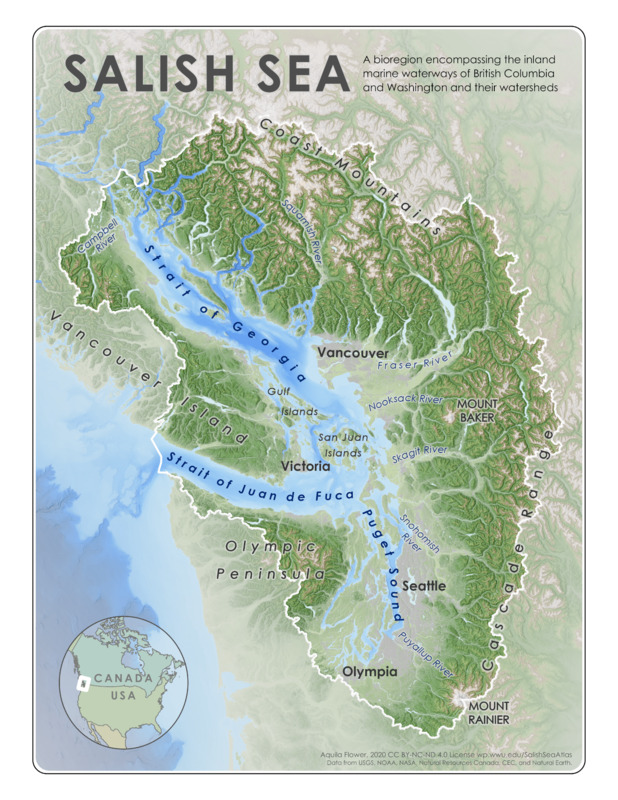
Article explaining why seismologists predict that east Puget Sound cities (Shoreline, Kirkland, Seattle, Lakewood, Redmond) will feel strongest shaking in the major earthquake that will occur on the Cascadia subduction zone. Notes that factors like construction quality and soil conditions will affect levels of damage.
Article about how Victoria, B.C. is especially vulnerable to earthquake damage. The city is threatened by several types of earthquakes, and its historic buildings are unprepared for the projected destructive impact.
Seattle’s Office of Emergency Management provides basic information about earthquakes. Lists three types of potential earthquakes, projected effects, and secondary impacts such as landslides, tsunamis, fires, infrastructure failures, and hazardous materials releases.
Article about the major earthquake projected to occur on the Cascadia subduction zone and the unpreparedness of the region. Explains the region’s history of earthquakes, increased scientific understanding and seismological predictions, and the casualties, destruction, and economic collapse that may result. Highlights the danger of the discrepancy between scientific information and the region’s preparedness.
Webpage tracking recent earthquakes in Southwestern British Columbia. Includes links to recent earthquake reports and an interactive map displaying all earthquakes in the last thirty days.
Article about how individuals can prepare for the major earthquake projected to occur on the Cascadia subduction zone. Recommendations include bolting homes to foundations, creating earthquake kits, and making exit plans.
The exercise is aimed to help students explain the basic chronology of culture history in the Salish Sea and identify important local archaeological sites and/or traditional cultural places on both sides of the international border.
The purpose of the IED is to prioritize improved educational outcomes for Indigenous learners by promoting practices informed by Indigenous perspectives and ways of knowing.
This program is built on the definition of health, including environmental health, as founded on the cooperative relationships between humans, non-humans, and their environment.
Grounded in the view that increased student success can be achieved through adjustments in pedagogy and approach that make mathematics feel more inclusive and engaging.
Survive the Sound is a free, interactive online game where students and the general public are invited to follow their favorite fish character as it migrates through Puget Sound.
"We are a collaborative network of educators, families, and community partners working to cultivate equitable, culturally thriving, socio-ecological systems learning and ethical decision-making using field-based science education in outdoor places, including gardens, for children in pre-kindergarten to 3rd grade and their families."
An article advocating for integrating Traditional Ecological Knowledge (TEK) into ecosystem science and management. It emphasizes the value of TEK in enhancing ecological understanding, informing impact assessments, and supporting co-management strategies.
A website created by a number of state, federal, tribal, academic, and private agencies that explains different measures of ecosystem health in Puget Sound. The website features an interactive diagram which can be clicked on to learn about each vital sign.
A biography of Billy Frank Jr. (Nisqually) by Trova Heffernan which chronicles Billy Frank Jr.’s life and role in the fight for treaty rights in the 1960s and 1970s, eventually resulting in the Boldt decision.
A 2021 article arguing that land education in early childhood education disrupts settler colonial narratives by centering Indigenous knowledge and environmental relationships. The authors argue that this approach supports critical reflection of education and supports decolonizing education.
A volume of essays with contributions from a number of Indigenous and non-Indigenous scholars and leading voices in ethnoecology, Indigenous law, and philosophy. It includes perspectives on reconciliation, environmental sustainability, and pathways toward ethnoecological restoration.
A website by the Swinomish Indian Tribal Community that describes a number of Indigenous Health Indicators, such as community connection, traditional education, cultural use, and more.
A guidebook by Royal Roads University and University of Victoria supporting the Indigenization of post-secondary education, particularly in British Columbia. It emphasizes the importance of decolonization, reconciliation, and cultural safety in creating equitable learning environments.
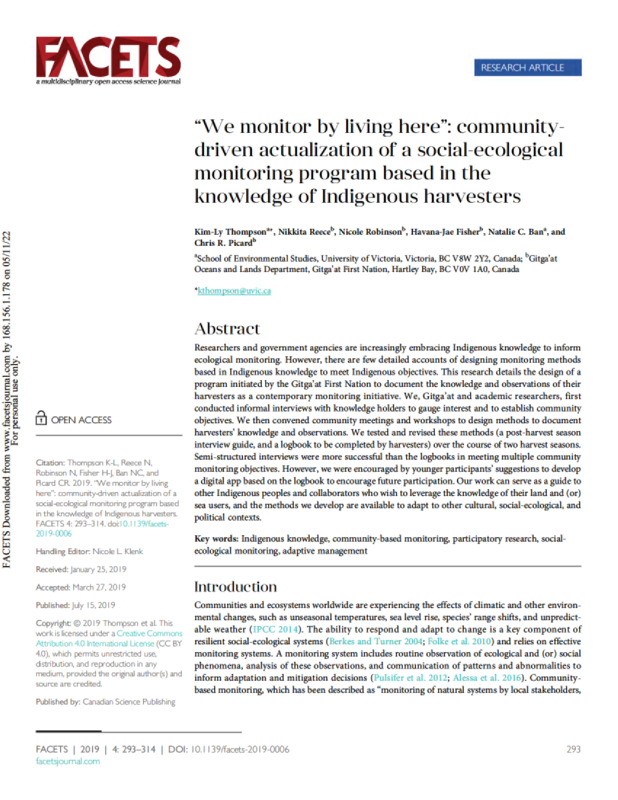
A 2019 study co-authored by Gitga’at First Nation and University of Victoria researchers that developed a social-ecological monitoring program rooted in Indigenous knowledge. It is intended to serve as a model for integrating Indigenous knowledge into ecological monitoring efforts.
An article about a comprehensive study (the First Nations Food, Nutrition and Environment Study or FNFNES) by the Assembly of First Nations, University of Ottawa, and Université de Montréal on levels of food insecurity in First Nations communities. The research explains how environmental degradation diminishes access to traditional foods, which impacts the health of First Nations individuals, and how there is an urgent need for policy to address these issues.
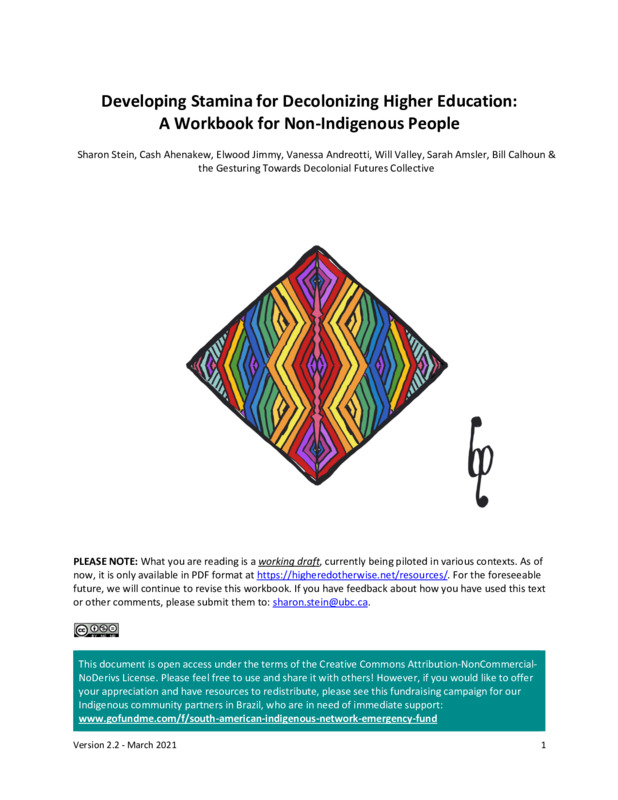
A practical guide for non-Indigenous people aiming to decolonize higher education, written in collaboration between Indigenous and non-Indigenous people. It emphasizes the importance of emotional resilience, self-reflection, accountability, and a long-term commitment to decolonization work.
Hear the story of the Japanese American incarceration experience from those who lived it, and find thousands of historic photographs, documents, newspapers, letters and other primary source materials from immigration to the WWII incarceration and its aftermath.
Connects everyone to the dynamic history, cultures, and art of Asian Pacific Americans through vivid storytelling and inspiring experiences to advance racial and social equity.
Includes photographs, maps, newspapers, posters, reports and other media from the University of Washington Libraries (including Special Collections), University of Washington Faculty and Departments, and organizations that have participated in partner projects with the UW Libraries.
Alaska to Northern California, and from the Pacific to the Rocky Mountains, with a particular focus on northwest Washington, the Olympic Peninsula, British Columbia, and Alaska
Report from marine scientist Kathryn Sobocinski, Western Washington University, and the Salish Sea Institute. It compiles information on the Salish Sea estuarine ecosystem including climate change, urbanization and human impacts, opportunities for better understanding, and a call to action on the future of the Salish Sea.
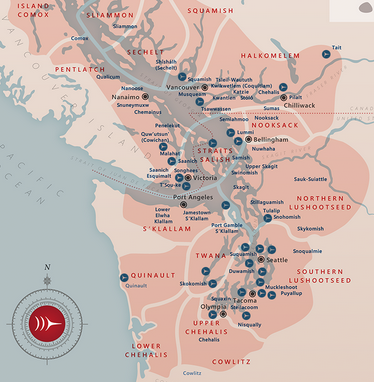
An interactive map by the Burke Museum of Coast Salish languages in the Salish Sea region. It features several pieces of art made by Coast Salish artists which can be clicked on to learn more. It also labels modern-day tribal communities and cities.
An academic article by Brian Tucker and Reuben Rose-Redwood analyzing the naming of the Salish Sea and its implications for Indigenous recognition and state authority. It explores how toponymy can both acknowledge Indigenous histories and perpetuate colonial power structures.
A book by historian Coll Thrush that explores the Indigenous history of Seattle, focusing on how Indigenous peoples have shaped the city from Duwamish villages to the present. It emphasizes the continued presence of Coast Salish peoples within Seattle and highlights the contributions of Urban Indian communities to the city's history and culture.